The oldest Eastern Shore chapter of Maryland Ornithological Society, Established in 1951
About
Founded by the late Jerry and Roberta Fletcher in March 1951, the Caroline County Bird Club was the first established chapter of the Maryland Ornithological Society on the Eastern Shore.
The Maryland Ornithological Society was founded in 1945 as a nonprofit, statewide organization of people who are interested in birds and nature to promote the study and enjoyment of birds. The Society also maintains a system of sanctuaries to encourage the conservation of birds and bird habitat and to help record and publish observations of bird life. The Myrtle Simons Pelot Sanctuary on Drapers Mill Road outside of Greensboro is one of these sanctuaries.
Currently the Caroline County Bird Club holds meetings on the third Saturday at the Wharves of Choptank Visitor & Heritage Center in Denton September - November, and January – May, featuring special speakers. Additionally, the Club offers bird walks throughout the year and an annual BigSit! birding event in October.
Citizen science is a big part of what the Caroline County Bird Club members are involved in, participating in a Fall Bird Count, a Christmas Bird Count and a May Bird Count each year in Caroline County. Members participated all three MD & DC Breeding Bird Atlas projects and continue to participate in Audubon’s Climate Watch survey. There is always room for additional people to help with the counts, even if it is just counting birds in your yard!
The Caroline County Bird Club is led by an elected slate of officers who are elected to two-year terms. The club also has a representative who sits on the Board of Directors of the Maryland Ornithological Society and a member who sits on the MOS Sanctuary Committee.
The Caroline County Commissioners named the Eastern Blue Bird (Sialia sialis) the Official County Bird in 1985. The Caroline County Bird Club’s official logo includes the Eastern Blue Bird. Our logo was created by Rob Brownlee-Tomasso.
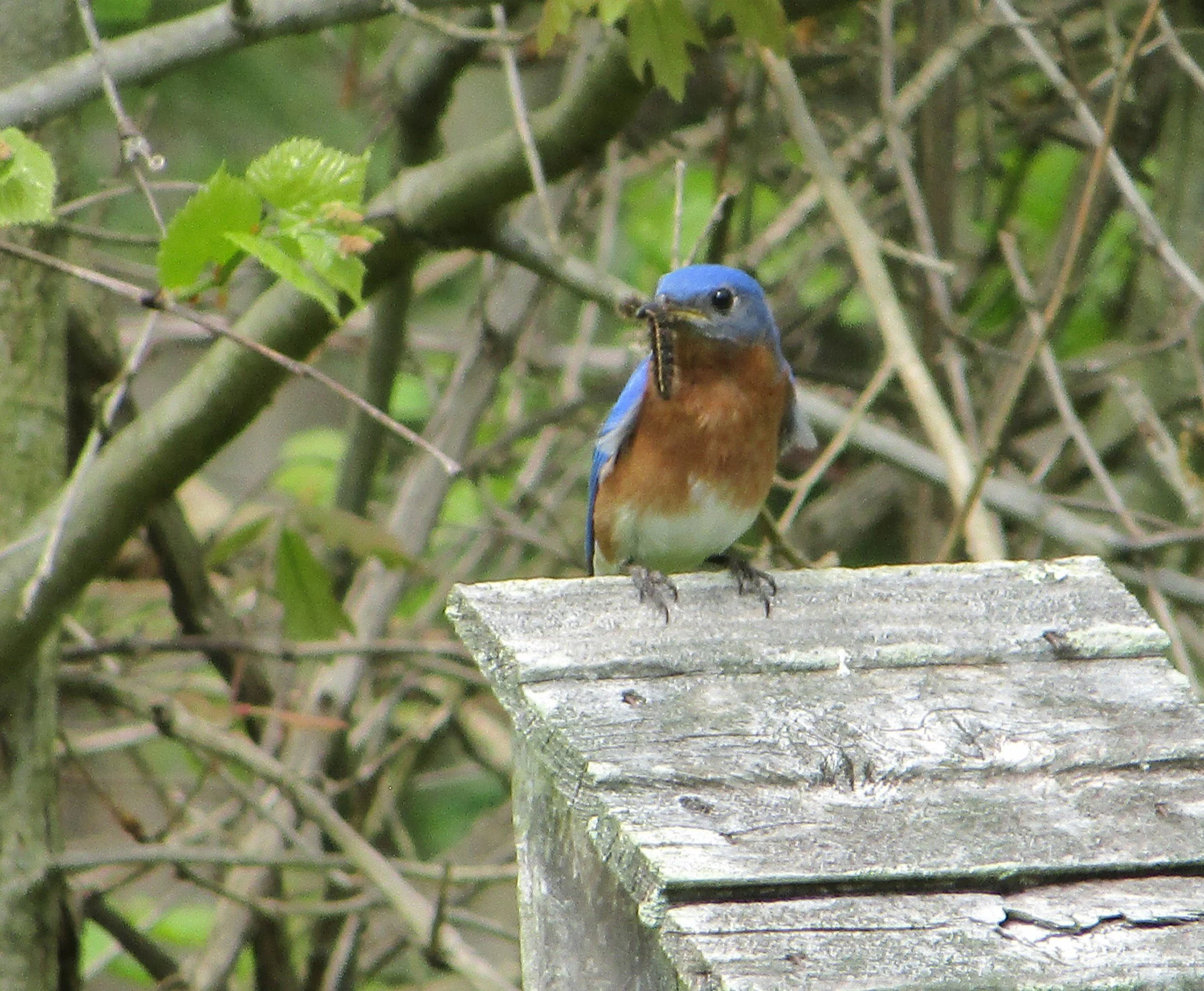
Eastern Bluebird
Sialia sialis
Caroline County Bird and Town of Denton’s Signature Bird
The Eastern Blue Bird (Sialia sialis) is related to the American Robin and other birds in the thrush family. This beautiful, small thrush has a plump body, large rounded head, and short bill. Males have a bright blue back and head, a reddish-orange throat and breast, and a white belly, while females are duller with grayish-blue upper parts and a muted orange-brown breast. They inhabit open woodlands and farmlands in eastern North America and are known for their vibrant blue color and melodious song. They eat mostly insects and berries, which can be provided in home landscaping and container gardens. Have you seen them in your yard or around town?
This bird is a cavity dweller. Competition from invasive species like the European Starling and English House Sparrow, habitat loss from reduced farmlands and the removal of dead trees, and the use of pesticides like DDT caused this bird’s numbers to decline to an alarming level by the middle of the 20th Century. In addition to the ban of DDT and other harmful pesticides, people began building blue bird nesting boxes and installed and monitored the boxes in habitats favorable to the blue bird.
Caroline County Bird Club members actively built, sold and installed blue bird nesting boxes for decades, helping the Eastern Blue Bird population in Caroline County to recover. Some Caroline County Bird Club members created and monitored Blue Bird trails, which included multiple nesting boxes. The Club has handwritten reports from the late Inez Glime, who managed bluebird trails in the Smithville area back in the 1980s. The Adkins Arboretum has maintained a blue bird trail of 20 boxes for 20 years. Staff and volunteers actively monitor the blue bird trail.
The Caroline County Commissioners named the Eastern Blue Bird the Official County Bird back in 1985. The Caroline County Bird Club’s official logo includes the Eastern Blue Bird.
For more information about the Eastern Blue Bird, visit the Cornell Labs All About Birds website overview For information on how to create a Blue Bird trail, visit the Silalis or contact the Adkins Arboretum.